May 28, 2026
Enterprise Teams Don’t Need More AI Tools. They Need Better Systems.
Better systems are more valuable than an ever-growing AI tool quill
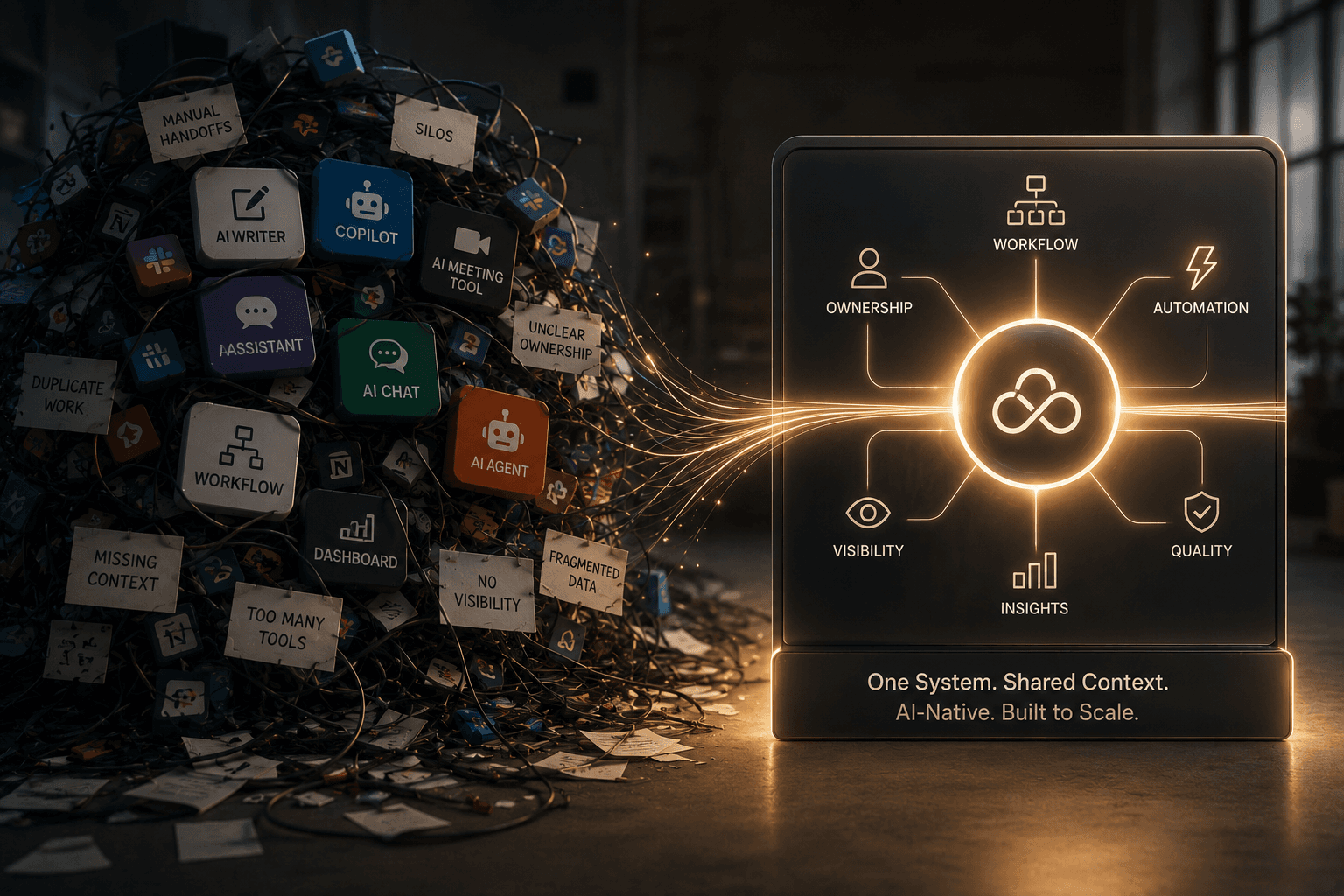
Right now, enterprise organizations are being flooded with AI tools.
AI writing tools. AI meeting tools. AI workflow tools. AI copilots. AI assistants. AI dashboards. AI agents. AI automation layers.
Most companies are experimenting aggressively.
But many organizations are making the same mistake: They are layering AI onto broken operational systems.
And that rarely creates long-term leverage.
AI Does Not Automatically Fix Operational Complexity
One of the biggest misconceptions in enterprise technology is the assumption that AI inherently simplifies organizations.
In practice, AI often increases operational complexity first.
Why?
Because AI dramatically increases the volume and speed of work moving through systems.
Suddenly organizations can generate:
more drafts
more updates
more documentation
more tasks
more assets
more metadata
more recommendations
more operational events
But the surrounding infrastructure often remains unchanged.
The same:
approval systems
workflow bottlenecks
ownership ambiguity
fragmented tooling
operational blind spots
QA processes
reporting gaps
still exist.
The organization simply experiences those problems at higher velocity.
Most Enterprise AI Strategies Are Tool-Centric
A surprising number of enterprise AI initiatives focus almost entirely on tooling.
Questions like:
Which model should we use?
Which AI vendor should we adopt?
Which assistant is most powerful?
Which AI platform integrates best?
dominate the conversation.
But these are often secondary questions.
The more important question is: Can the organization operationalize AI-generated throughput effectively?
Because without strong systems:
AI creates noise
workflows become unstable
quality declines
ownership becomes unclear
operational coordination breaks down
Eventually, organizations begin slowing AI adoption simply to preserve operational stability.
The Real Opportunity Is System Design
The highest leverage AI work inside enterprises may not be prompt engineering or model selection.
It may be operational systems design.
How does work move? How are states managed? How are validations enforced? How are failures surfaced? How is ownership tracked? How are exceptions handled? How do systems coordinate autonomously?
These are infrastructure questions.
And increasingly, they are the questions determining whether enterprise AI efforts succeed or fail.
AI-Native Organizations Operate Differently
Organizations designed around AI-native workflows will likely look structurally different from traditional enterprises.
Historically, workflows depended heavily on human coordination.
Humans:
routed work
checked requirements
monitored systems
escalated issues
coordinated dependencies
tracked status
maintained operational awareness
AI-native systems increasingly absorb many of these responsibilities directly.
That changes the role humans play inside operations entirely.
Instead of manually coordinating every workflow step, humans increasingly focus on:
oversight
exception management
systems optimization
strategic decisions
escalation handling
The organization becomes less dependent on constant manual orchestration.
Workflow Infrastructure Is Becoming Strategic Infrastructure
Historically, workflow systems were often viewed as internal operational utilities.
Necessary, but secondary.
That mindset no longer holds.
In modern enterprises, workflow infrastructure directly impacts:
scalability
operational efficiency
reliability
AI leverage
margin structure
publishing velocity
organizational responsiveness
As AI lowers the cost of production, operational coordination becomes increasingly valuable.
This means workflow infrastructure is no longer simply process management.
It becomes strategic infrastructure.
The Future Enterprise Stack Is Operationally Intelligent
Many enterprise systems today are still passive.
They store information. They expose interfaces. They wait for humans to coordinate action.
That model is changing.
The next generation of enterprise platforms will increasingly:
monitor workflows continuously
validate requirements automatically
route work dynamically
detect operational risk
trigger remediation
coordinate systems autonomously
escalate only when necessary
In other words: enterprise platforms themselves become operational participants.
Not just tools humans operate manually.
The Winners Will Build Systems, Not Just AI Features
Over time, access to powerful AI models will become increasingly commoditized.
Most enterprises will eventually have similar generative capabilities.
The differentiator will not simply be: “Who has AI?”
It will increasingly be: “Who built systems capable of operationalizing AI effectively?”
That is a much harder problem.
And much more defensible.
Final Thought
Enterprise organizations do not simply need more AI tools layered onto existing workflows.
They need systems designed for an environment where AI dramatically increases operational throughput.
Because AI changes the economics of production.
And once production accelerates, operational coordination becomes the real challenge.
The organizations that recognize this early will likely build entirely different kinds of enterprise systems over the next decade.
Not just AI-assisted systems.
AI-native operational systems.