May 21, 2026
The Future of Enterprise Platforms Is Fewer Humans Touching the System
Enterprise level Editorial teams are gone. Key stakeholders owning production start to finish has arrived.
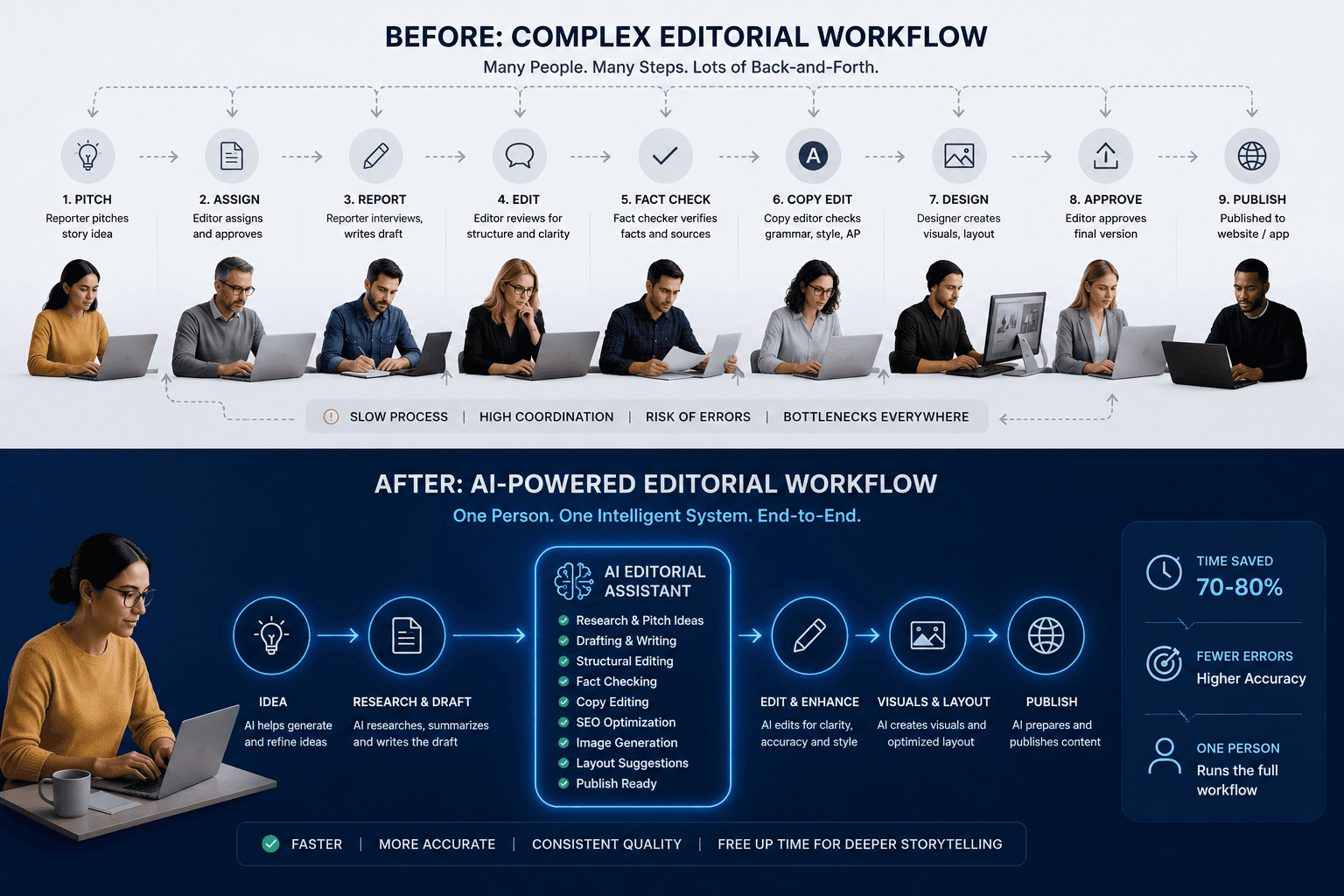
For decades, enterprise software was designed around human coordination.
Humans moved work between stages. Humans reviewed outputs. Humans validated metadata. Humans routed approvals. Humans monitored operations. Humans enforced process consistency.
Entire industries were built around helping people manually coordinate increasingly complex systems.
That operational model is beginning to change.
Not because enterprises suddenly became more efficient.
Because AI is fundamentally changing the economics of operational work.
Enterprise Systems Were Built Around Human Limitations
Most enterprise workflows evolved during a period where human throughput was the primary constraint.
That shaped how platforms were designed:
workflows optimized for human review
approval chains designed around managerial oversight
dashboards designed for manual monitoring
QA systems dependent on human validation
operational routing handled through people
coordination spread across meetings, spreadsheets, and messaging platforms
This made sense when humans were the primary producers of work.
But AI dramatically changes output capacity.
Organizations can now generate:
content
assets
summaries
metadata
reports
code
documentation
support responses
workflow actions
at a scale traditional operational systems were never designed to absorb.
This creates a critical enterprise problem: The coordination layer collapses before production capacity does.
More Output Is Not the Same as More Scale
One of the biggest misconceptions in enterprise AI is the assumption that higher production automatically creates scalability.
In reality, increased output often exposes operational fragility.
A system producing ten pieces of work per day can survive inefficient coordination.
A system producing ten thousand cannot.
At scale, even small operational inefficiencies become systemic risks:
broken approvals
missed validations
publishing errors
inconsistent metadata
failed syndication
routing confusion
ownership gaps
monitoring blind spots
AI accelerates production faster than most organizations can evolve operational governance.
That imbalance is where many enterprise systems begin failing.
The Real Goal Is Reducing Human Operational Touches
The future of enterprise platforms is not simply “AI-assisted work.”
It is systems designed to minimize unnecessary human operational involvement entirely.
That does not mean humans disappear.
It means humans increasingly move toward:
strategic intervention
exception management
oversight
system design
escalation handling
optimization
while routine operational coordination becomes automated.
This is a major philosophical shift.
Historically, enterprise software focused on helping humans manage workflows.
Modern enterprise systems increasingly focus on eliminating the need for humans to manage routine workflows at all.
The Rise of Autonomous Operational Layers
This is why enterprise platforms are beginning to evolve beyond static tooling.
The next generation of operational systems will increasingly include:
automated validation engines
AI-driven workflow routing
operational readiness scoring
dynamic assignment systems
automated QA
exception escalation
continuous monitoring
workflow observability
system-triggered remediation
orchestration layers coordinating multiple tools simultaneously
In many ways, enterprise platforms are becoming less like software products and more like operational environments.
The platform itself becomes an active participant in managing work.
Exception-Based Operations Become the Default
As AI systems mature, enterprise operations will likely shift toward exception-based models.
In this structure:
standard work flows automatically
systems enforce rules continuously
AI validates operational requirements
routing happens dynamically
humans intervene only when anomalies or exceptions occur
This dramatically reduces operational overhead.
But more importantly: it changes organizational structure itself.
The highest-performing organizations may soon be the ones where the fewest humans are required to manually coordinate operational flow.
The Organizations That Adapt Fastest Will Compound Advantages
This transition will likely create significant separation between organizations.
Some companies will continue layering AI onto legacy operational systems built for manual coordination.
Others will redesign operational architecture entirely around AI-native throughput.
The second group will compound advantages much faster.
Because operational efficiency itself becomes scalable.
Not through outsourcing. Not through headcount growth. Not through process documentation.
But through systems capable of coordinating complexity autonomously.
Enterprise Platforms Are Becoming Systems of Execution
Historically, enterprise software categories often focused on:
storage
documentation
communication
reporting
Increasingly, platforms are evolving into systems of execution.
Their purpose is no longer simply to store work.
Their purpose is to actively move work through organizations with minimal operational friction.
That changes how enterprise software is designed. It changes how teams operate. And ultimately, it changes how companies scale.
Final Thought
The next generation of enterprise platforms will likely be defined less by how many features they offer and more by how effectively they reduce human operational overhead.
Because AI changes the economics of production.
And once production becomes abundant, operational coordination becomes the true bottleneck.
The organizations that win will not necessarily be the ones with the most AI.
They may be the ones where the fewest humans are required to manually operate the system at all.