May 2, 2026
Why Workflow Infrastructure Is Becoming a Competitive Advantage
Workflow infrastructure is becoming increasingly valuable to enterprise platforms
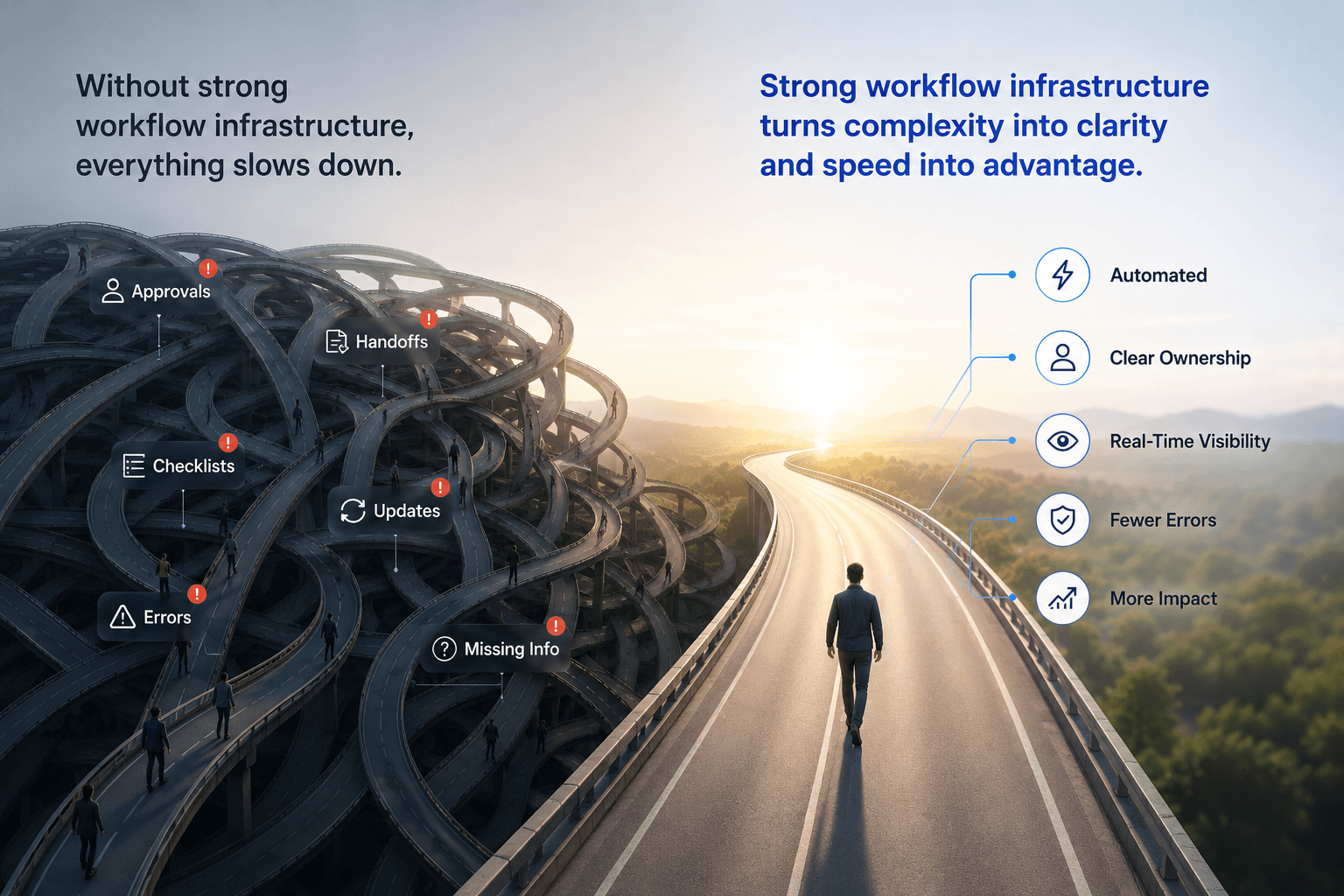
For a long time, workflow infrastructure was treated as operational overhead.
Necessary. Unavoidable. But rarely strategic.
Most organizations viewed workflow systems as internal coordination tools:
approval flows
assignment systems
publishing checklists
reporting dashboards
notifications
operational processes
Important for keeping teams organized, but not directly tied to competitive advantage.
That assumption is beginning to break down.
In the AI era, workflow infrastructure is increasingly becoming one of the most important leverage points inside enterprise organizations.
AI Changes the Value of Operational Efficiency
Historically, scaling production often required scaling people.
More output meant:
more editors
more coordinators
more project managers
more QA
more approvals
more operational overhead
AI changes this equation dramatically.
Organizations can now generate far more:
content
assets
code
documentation
metadata
analysis
workflow actions
without scaling headcount proportionally.
But this creates a new constraint: Operational coordination.
The bottleneck moves from production to orchestration.
And that shift fundamentally changes the value of workflow infrastructure.
Throughput Becomes Strategic
In many enterprise environments, especially publishing and operational platforms, throughput directly impacts business performance.
Faster systems can:
publish more content
react faster to trends
update information more efficiently
support more distribution channels
reduce operational delays
increase monetizable output
improve syndication performance
reduce revenue-impacting failures
At scale, even small workflow inefficiencies compound aggressively.
A missed publish window. A broken approval chain. An invalid metadata field. A failed syndication payload. An unclear ownership state.
These are no longer isolated operational annoyances.
They become business problems.
Most Enterprise Workflows Were Never Designed for AI Scale
Many enterprise operational systems were built during an era where humans were the limiting factor.
The assumption was: Humans create work slowly enough that humans can manually coordinate it.
That assumption no longer holds.
AI can now generate operational volume far faster than traditional workflows can safely process.
This creates hidden instability inside organizations.
Suddenly:
approvals back up
routing breaks
QA becomes inconsistent
ownership becomes unclear
operational visibility disappears
publishing reliability declines
Organizations often interpret this as an “AI problem.”
In reality, it is usually an infrastructure problem.
Workflow Systems Are Becoming Revenue Systems
One of the most important shifts happening right now is the realization that workflow infrastructure directly influences business outcomes.
Especially in operationally intensive industries like:
publishing
media
ecommerce
support operations
software development
compliance-heavy environments
enterprise documentation systems
Workflow quality increasingly determines:
operational speed
organizational scalability
reliability
AI leverage
margin efficiency
output consistency
In many cases, the organizations that operate most efficiently will outperform organizations with objectively “better” AI capabilities.
Because AI without operational coordination creates diminishing returns.
The New Enterprise Advantage
Historically, enterprise software differentiation often centered around:
feature depth
UI quality
integrations
data storage
reporting
Increasingly, the differentiator is becoming operational execution.
How efficiently can a system move work from creation to completion? How little human coordination is required? How quickly can issues be identified? How effectively can complexity be absorbed without operational degradation?
These are workflow infrastructure questions.
And they are becoming strategically important.
Workflow Infrastructure Is Quietly Becoming a Product Category
Many organizations are already discovering that modern operational needs extend far beyond traditional CMS or project management tooling.
There is a growing gap between:
content systems
operational systems
AI systems
orchestration systems
This gap is creating demand for new infrastructure layers focused specifically on:
operational coordination
workflow automation
validation
observability
readiness scoring
exception handling
AI governance
cross-system orchestration
In many ways, enterprise operations are becoming programmable systems.
The Organizations That Solve Coordination Will Compound Faster
AI lowers the cost of production.
But as production becomes cheaper, coordination becomes more valuable.
That changes where competitive advantage comes from.
The organizations that scale most effectively over the next decade may not simply be the ones creating the most output.
They may be the ones with operational systems capable of coordinating complexity with the least amount of friction.
Because eventually, nearly every enterprise will have access to powerful AI.
But not every enterprise will have infrastructure capable of operationalizing it effectively.
Final Thought
For years, workflow systems were treated as secondary infrastructure.
Now they are becoming central infrastructure.
Because in an AI-driven environment, operational coordination is no longer just about organization.
It directly impacts:
speed
reliability
scalability
efficiency
revenue
competitive execution
And increasingly, that makes workflow infrastructure a competitive advantage in its own right.