May 21, 2026
Headless CMS Platforms Are Missing the Most Important Layer
Workflow suffers with headless systems
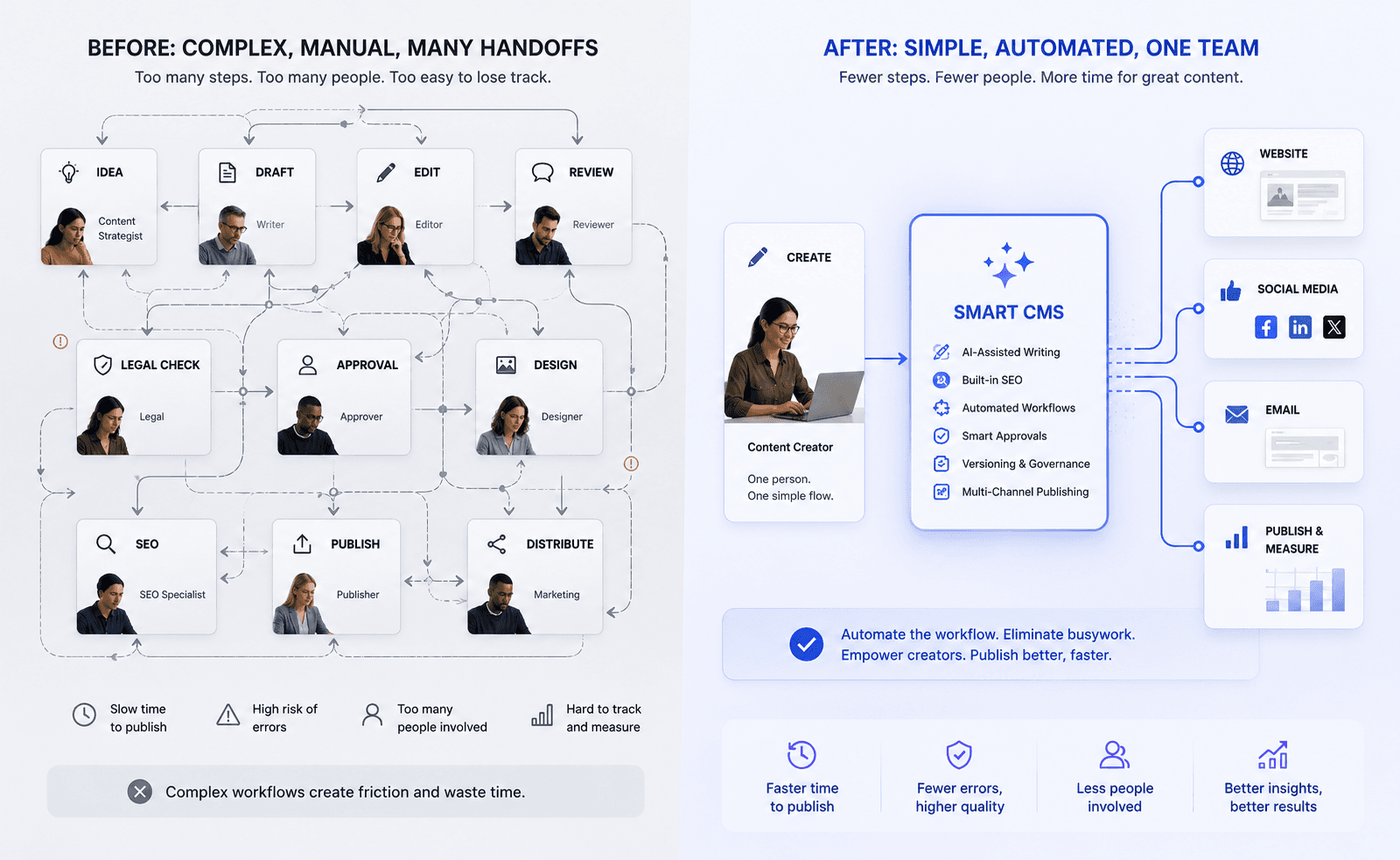
Headless CMS platforms solved a major enterprise problem.
They separated content from presentation.
That shift unlocked:
omnichannel publishing
API-first architectures
composable systems
frontend flexibility
scalable content modeling
faster developer workflows
It was a necessary evolution.
But as enterprise organizations mature inside modern CMS ecosystems, a new problem becomes increasingly obvious:
Most headless CMS platforms stop at content management.
Enterprise organizations need operational management.
And those are not the same thing.
The Missing Operational Layer
Most headless CMS platforms are extremely good at:
content modeling
APIs
localization
structured data
delivery architecture
frontend flexibility
But large enterprise organizations quickly discover they still need to build or integrate systems for:
assignments
ownership
workflow states
editorial coordination
publishing readiness
operational QA
syndication validation
approvals
notifications
reporting
queue management
visibility across teams
In practice, this means organizations often end up recreating an operational layer outside the CMS itself.
Usually through:
Jira
Slack
spreadsheets
Airtable
Notion
custom internal tooling
disconnected workflow SaaS products
The result is operational fragmentation.
Content may live in one system, but operational coordination lives everywhere else.
The Enterprise Reality Most Platforms Ignore
This gap becomes far more painful at enterprise scale.
Especially when organizations manage:
multiple brands
hundreds of editors
distributed workflows
partner syndication
complex metadata requirements
high publishing velocity
revenue-sensitive publishing windows
At that scale, content itself is rarely the hardest problem.
Operational coordination becomes the real challenge.
Questions like:
Who owns this?
Is this ready for publish?
Did validation pass?
Are required fields complete?
Has legal reviewed this?
Is syndication metadata compliant?
Was this distributed correctly?
Which queue is this in?
Why did this fail?
What changed between revisions?
become operationally critical.
And most CMS platforms were never designed to answer them.
Headless Architecture Created New Operational Complexity
Ironically, the flexibility that made headless CMS systems powerful also increased operational complexity.
In monolithic systems, workflows were often tightly coupled to publishing infrastructure.
Headless systems intentionally decoupled those layers.
That improved scalability and flexibility.
But it also created coordination gaps.
Organizations now must orchestrate workflows across:
CMS platforms
frontend frameworks
DAM systems
analytics platforms
syndication APIs
Jira
Slack
AI tooling
publishing pipelines
internal business systems
As organizations add AI-generated workflows into this environment, operational complexity increases even further.
This is where many enterprise publishing systems begin breaking down.
AI Makes the Missing Layer Impossible to Ignore
AI is accelerating content operations faster than operational systems are evolving.
Organizations can now generate:
drafts
revisions
summaries
metadata
images
structured content
SEO recommendations
translations
tagging
optimization suggestions
at enormous scale.
But AI-generated output still needs operational governance.
Without strong workflow infrastructure:
errors multiply
ownership becomes unclear
quality degrades
operational overhead increases
publishing instability grows
This is why many organizations are beginning to realize: The missing operational layer is becoming more important than the CMS itself.
The Future CMS Stack
The next generation of enterprise CMS ecosystems will likely look very different from today’s implementations.
The CMS will remain foundational.
But surrounding it will increasingly be operational infrastructure responsible for:
orchestration
validation
readiness scoring
assignment management
AI coordination
workflow automation
exception handling
observability
operational QA
publishing governance
In many organizations, this operational layer may eventually become its own product category entirely.
Not a CMS replacement.
But a system designed specifically to coordinate enterprise publishing operations around the CMS.
Workflow Infrastructure Is Becoming Strategic
Historically, workflow tooling was often treated as internal operational overhead.
That mindset is changing.
In modern publishing organizations, workflow infrastructure directly impacts:
publishing velocity
revenue generation
partner distribution performance
operational scale
AI leverage
error reduction
organizational efficiency
As AI increases throughput, operational coordination becomes increasingly strategic.
The organizations that solve workflow infrastructure well will likely compound advantages faster than those focused only on content generation.
Final Thought
Headless CMS platforms solved content architecture problems.
But enterprise organizations are now facing operational architecture problems.
And those problems are becoming more important as AI accelerates throughput across publishing systems.
The next major evolution in enterprise publishing may not come from better content management.
It may come from better operational orchestration surrounding content management entirely.