May 19, 2026
The Future of Enterprise Operations Is Observability
Most enterprise organizations are far less operationally aware than they think they are.
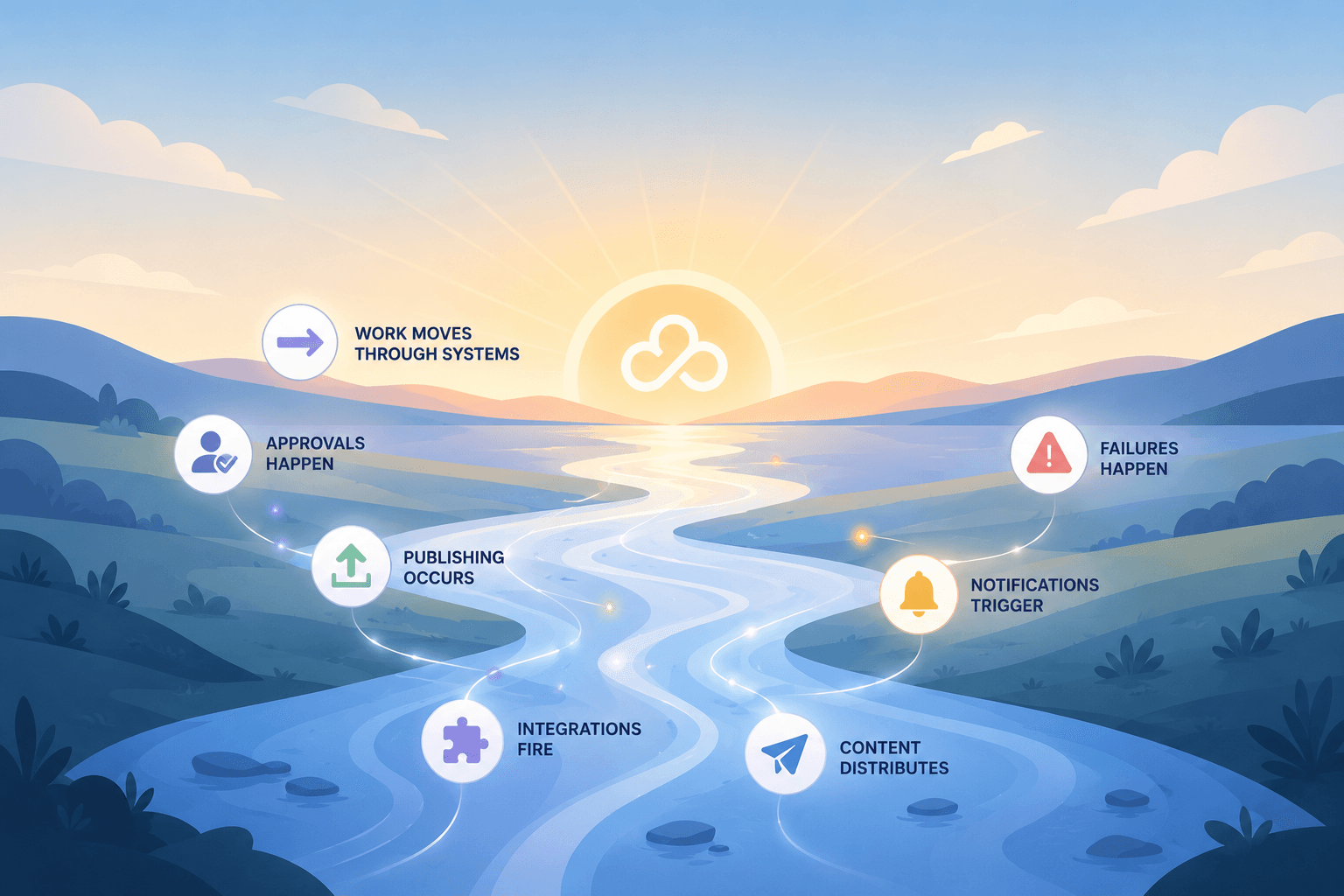
Work moves through systems. Approvals happen. Publishing occurs. Integrations fire. Content distributes. Notifications trigger. Failures happen.
But in many organizations, operational visibility is surprisingly fragmented.
Teams often rely on:
dashboards
spreadsheets
Slack messages
manual QA
spot checking
tribal knowledge
reactive debugging
to understand whether systems are functioning correctly.
That model becomes increasingly unstable in an AI-driven operational environment.
AI Increases Operational Complexity Faster Than Visibility
One of the biggest effects AI has on enterprise systems is operational acceleration.
More workflows execute simultaneously. More events trigger. More content moves. More automation layers interact. More systems coordinate in parallel.
This creates dramatically more operational surface area.
Historically, humans could often compensate for weak observability because throughput remained relatively manageable.
But AI changes the scale entirely.
Organizations can no longer depend on humans manually maintaining operational awareness across increasingly autonomous systems.
The complexity becomes too large.
Most Enterprise Operations Are Surprisingly Reactive
A large percentage of enterprise operational work today is still reactive.
Teams discover problems after:
workflows fail
publishing breaks
metadata becomes inconsistent
syndication errors occur
customers notice issues
traffic declines
systems become blocked
This is especially common in operationally intensive environments like:
publishing
ecommerce
logistics
support operations
enterprise integrations
workflow-heavy SaaS platforms
The systems themselves often lack deep awareness of operational state.
Humans remain responsible for discovering instability.
That model does not scale effectively in AI-native environments.
Operational Observability Is Becoming Core Infrastructure
Historically, observability was treated primarily as an engineering concern.
System logs. Infrastructure monitoring. Application uptime. Performance metrics.
But enterprise operations increasingly require workflow observability as well.
Organizations need systems capable of understanding:
where work exists
which workflows are blocked
which validations failed
where operational risk is increasing
which systems are degrading
which outputs are unstable
which dependencies are failing
where throughput is slowing
which operational anomalies require escalation
This is not just technical monitoring.
It is operational awareness infrastructure.
Enterprise Systems Are Becoming Dynamic Operational Environments
Traditional enterprise software was largely passive.
Data existed inside systems, but humans interpreted operational meaning.
AI-native enterprise environments are different.
Modern systems increasingly:
evaluate workflows continuously
monitor operational conditions
detect anomalies
identify bottlenecks
assess readiness
coordinate remediation
escalate exceptions automatically
The platform itself becomes operationally aware.
That is a major architectural shift.
The Goal Is Not More Dashboards
Many organizations respond to operational complexity by creating more dashboards.
But dashboards alone do not solve operational awareness problems.
Humans still must:
interpret signals
connect systems mentally
identify patterns
decide what matters
coordinate responses
That creates cognitive overhead at scale.
The future likely moves toward systems capable of:
understanding operational state directly
identifying meaningful risk automatically
surfacing actionable exceptions
coordinating remediation workflows dynamically
In other words: less passive reporting, more active operational intelligence.
AI Requires Continuous Operational Validation
As organizations automate more workflows, operational reliability becomes increasingly important.
AI-generated systems can create:
massive throughput gains
autonomous workflows
dynamic coordination
continuous optimization
But they can also amplify instability rapidly when operational governance is weak.
This means enterprise systems increasingly need:
continuous validation
real-time monitoring
workflow observability
operational state awareness
automated safeguards
intelligent escalation systems
Without these layers, organizations often discover operational failures only after business impact occurs.
The Future Enterprise Stack Will Be Self-Aware
Over time, enterprise systems will likely evolve toward environments that continuously understand their own operational condition.
Not consciousness.
Operational self-awareness.
Systems that understand:
workflow health
dependency integrity
operational readiness
throughput stability
risk conditions
failure propagation
coordination bottlenecks
This dramatically changes how organizations operate.
Humans increasingly move from: manually monitoring systems
to: managing exceptions surfaced by intelligent operational infrastructure.
Observability Becomes Competitive Infrastructure
As enterprise workflows become more autonomous, organizations with stronger operational awareness will compound advantages significantly faster.
Because operational instability becomes easier to:
detect
isolate
remediate
optimize
prevent
Organizations without these capabilities will increasingly struggle with hidden operational fragility.
Especially as AI continues increasing throughput and complexity.
Final Thought
The future of enterprise operations may depend less on how much work organizations can generate and more on how effectively they can observe, coordinate, and stabilize increasingly autonomous systems.
Because AI accelerates operational complexity faster than humans can manually manage it.
And eventually, organizations will need systems capable of understanding operational reality continuously — not just reporting on it after the fact.
That is where enterprise operations appear to be heading: toward intelligent, observable, continuously coordinated systems.