May 22, 2026
Enterprise Workflows Are Becoming Agentic
For years, enterprise workflows were fundamentally linear.
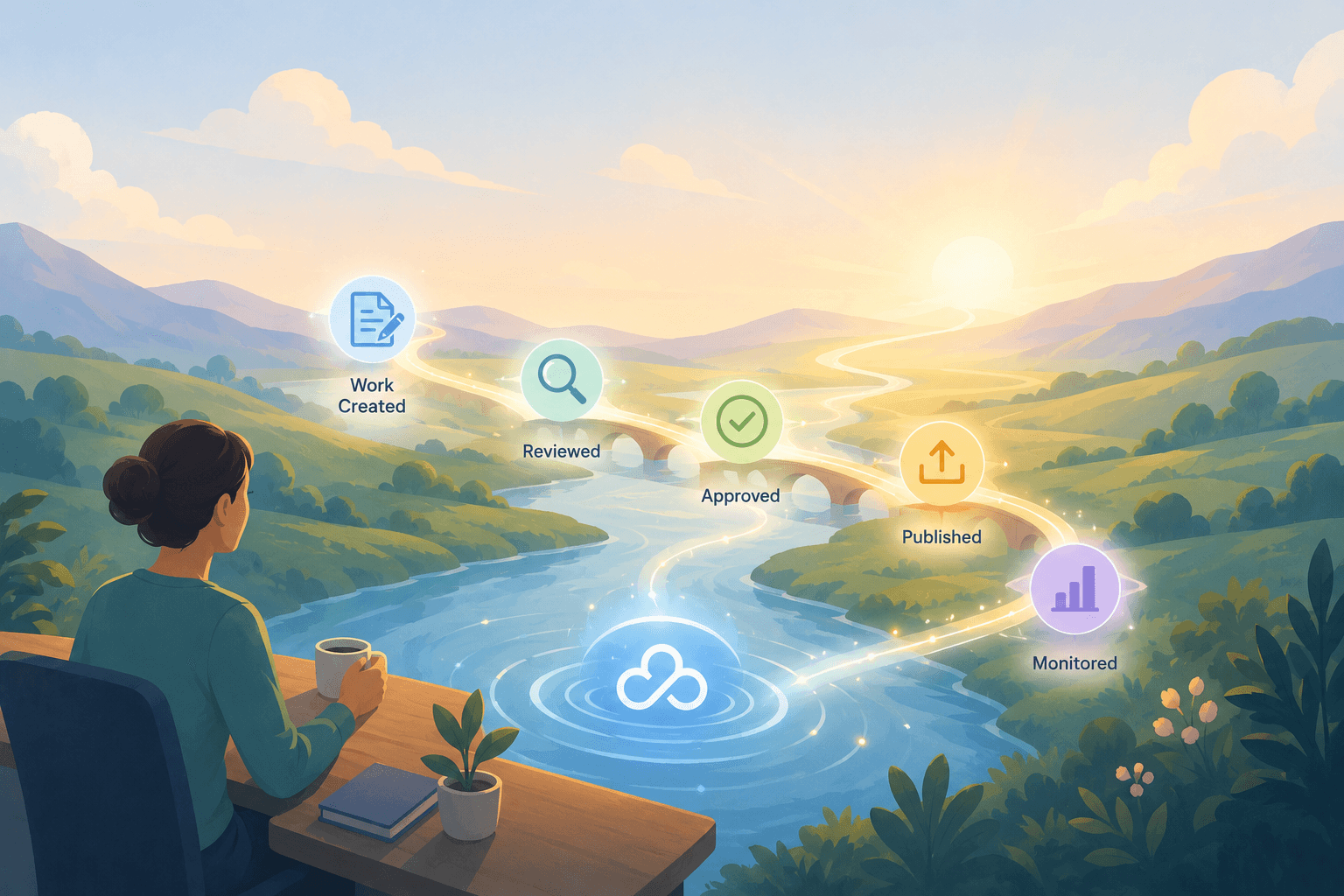
A person created work. Another person reviewed it. Another approved it. Another published it. Another monitored it.
Most operational systems were designed around predictable, sequential human coordination.
That model is beginning to change.
AI is not just accelerating workflows.
It is changing the nature of workflows themselves.
Traditional Enterprise Workflows Were Human Routing Systems
Historically, enterprise workflow software existed primarily to help humans coordinate tasks.
The systems themselves had very little operational intelligence.
They tracked:
status
ownership
timestamps
approvals
comments
notifications
But humans still made nearly all operational decisions.
Humans decided:
where work moved
who handled exceptions
when something was ready
what required escalation
what represented risk
how systems coordinated
Enterprise platforms were largely passive coordination environments.
That is beginning to shift.
AI Introduces Active Operational Participants
Modern AI systems increasingly behave less like tools and more like operational participants.
They can:
evaluate workflow state
validate requirements
detect inconsistencies
summarize context
recommend actions
trigger downstream processes
coordinate between systems
escalate anomalies
route work dynamically
This creates a fundamentally different operational model.
Instead of workflows being entirely human-driven, workflows increasingly contain autonomous decision-making layers.
In many enterprise systems, the workflow itself is becoming intelligent.
Agentic Systems Change Workflow Design Entirely
Most legacy enterprise workflows assume humans remain continuously involved throughout execution.
That assumption creates:
approval bottlenecks
routing overhead
coordination delays
operational fragmentation
dependency slowdowns
Agentic workflows change this model.
Instead of humans managing every step, systems increasingly:
coordinate tasks automatically
monitor readiness continuously
determine next actions dynamically
trigger validations autonomously
escalate only when necessary
This dramatically changes operational scale characteristics.
The workflow itself becomes adaptive rather than static.
Enterprise Platforms Are Moving From State Tracking to Decision Making
Traditional workflow platforms primarily tracked state.
A task was:
assigned
in review
approved
complete
But modern operational systems increasingly evaluate state in real time.
Not just: “What status is this in?”
But:
Is this operationally valid?
Does this meet publishing requirements?
Are dependencies satisfied?
Is escalation necessary?
Is downstream distribution safe?
Is the workflow healthy?
Does this require intervention?
This is a major architectural shift.
Enterprise systems increasingly move from: tracking workflows
to: actively managing workflows.
AI Agents Are Most Valuable Inside Operational Infrastructure
A lot of public discussion around AI agents focuses on personal productivity:
assistants
task automation
research helpers
coding copilots
But the biggest long-term impact may emerge inside enterprise operational infrastructure.
Especially in systems involving:
publishing
compliance
logistics
support operations
ecommerce
software delivery
large-scale content operations
These environments contain enormous amounts of structured operational logic.
That makes them highly compatible with agentic coordination systems.
The Real Opportunity Is Workflow Autonomy
The most important shift is not necessarily AI generation.
It is operational autonomy.
Can systems:
coordinate themselves?
validate themselves?
monitor themselves?
recover from instability?
reroute around failures?
maintain operational awareness continuously?
These are increasingly the defining enterprise infrastructure questions.
Because once workflows become partially autonomous, organizational scalability changes dramatically.
Humans Move Toward Oversight and Exception Handling
As workflows become more agentic, humans increasingly shift toward:
governance
escalation handling
systems optimization
policy definition
strategic oversight
operational tuning
The role of operations teams changes fundamentally.
Instead of manually coordinating every workflow step, humans increasingly supervise systems coordinating workflows autonomously.
This is very similar to what happened in infrastructure operations, cloud systems, and DevOps over the past decade.
Enterprise workflows now appear to be entering a similar transition.
Agentic Workflows Require Strong Operational Foundations
One important reality is often overlooked:
Agentic systems only work effectively when operational infrastructure is mature.
Weak systems create unstable autonomy.
Without:
validation
workflow clarity
dependency management
operational governance
structured states
agentic systems often amplify chaos rather than reduce it.
This is why workflow infrastructure becomes increasingly important in AI-native enterprises.
Autonomy requires operational structure.
The Future Enterprise Stack Becomes Operationally Active
Historically, enterprise platforms stored information and waited for humans to coordinate action.
The next generation of enterprise systems increasingly:
monitor workflows continuously
make operational decisions dynamically
coordinate systems automatically
surface meaningful exceptions
adapt workflows in real time
The software itself becomes operationally active.
Not fully autonomous organizations.
But increasingly autonomous operational systems.
Final Thought
Enterprise workflows are beginning to evolve from static human coordination systems into adaptive, agentic operational environments.
That shift changes how organizations scale.
Because once systems can actively coordinate work instead of simply tracking work, the limiting factor is no longer human operational throughput.
It becomes the quality of the operational architecture itself.
And increasingly, that architecture will determine which organizations can scale effectively in the AI era.