May 25, 2026
Most Enterprise AI Projects Fail Because They Automate the Wrong Layer
Enterprise AI Projects + Automation
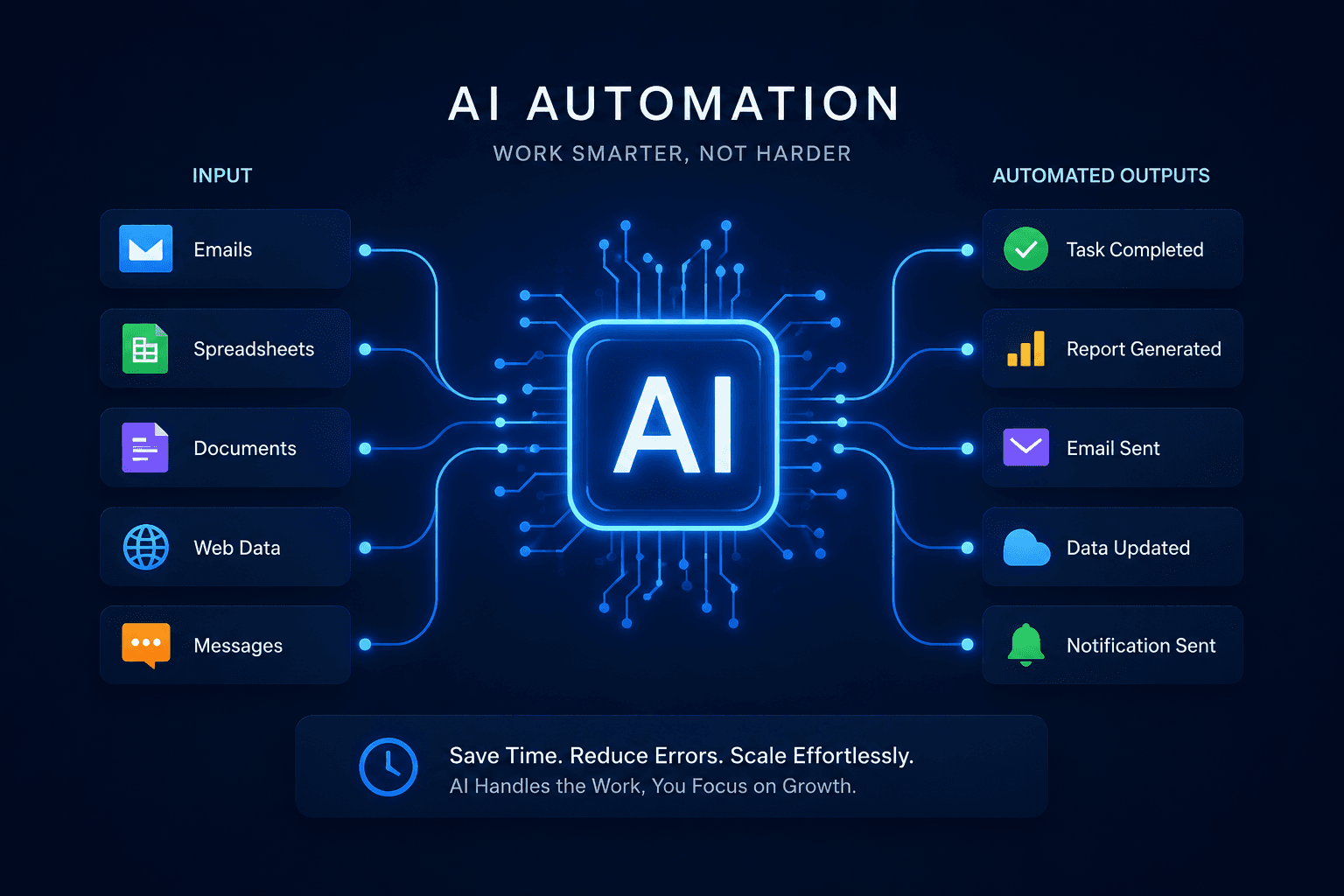
Right now, nearly every enterprise organization is trying to figure out how AI fits into their business.
The common assumption is: “If we can generate work faster, we become more efficient.”
So companies rush toward:
AI-generated content
AI summarization
AI copilots
AI automation tools
AI productivity assistants
AI search
AI workflows
But many enterprise AI initiatives quietly fail to create meaningful operational improvement.
Not because the AI is bad.
Because organizations are automating the wrong layer.
The Illusion of Throughput
Most enterprise systems are not bottlenecked by creation.
They are bottlenecked by operations.
This distinction matters enormously.
In large organizations, the real constraints are often:
approvals
workflow routing
operational QA
metadata consistency
cross-functional coordination
publishing readiness
exception handling
visibility gaps
operational ownership
fragmented tooling
These systems were already strained before AI.
Now AI dramatically increases the amount of operational load moving through them.
Organizations often interpret this increased volume as success.
In reality, they have simply accelerated chaos.
AI Magnifies Existing System Quality
One of the most important things organizations are beginning to realize is this:
AI amplifies system quality.
It does not replace it.
If workflows are fragmented, AI increases fragmentation.
If operational ownership is unclear, AI increases confusion.
If validation systems are weak, AI increases errors.
If publishing infrastructure is unreliable, AI increases instability.
This is why many organizations experience an early burst of excitement around AI adoption followed by operational fatigue.
The systems surrounding the AI were never designed for the new scale of throughput.
The Wrong Layer
Many enterprise AI projects focus on the visible layer of work:
generating content
generating code
generating summaries
generating designs
generating recommendations
But the highest leverage layer is often operational infrastructure.
The organizations creating long-term advantage are increasingly investing in:
workflow orchestration
automated validation
operational observability
metadata enforcement
queue systems
routing systems
readiness scoring
exception handling
AI-assisted QA
system coordination
These are not always flashy projects.
But they compound.
Because operational infrastructure determines whether AI-generated output can move safely and efficiently through the organization.
The Coming Operational Bottleneck
Over the next several years, many enterprise organizations will encounter the same problem: Their operational systems cannot support the volume AI enables.
This is already visible in areas like:
publishing operations
customer support
internal knowledge systems
software development
compliance workflows
enterprise documentation
data operations
AI increases production capacity faster than most organizations can evolve operational governance.
That creates organizational instability.
Not because AI creates bad output.
Because organizations lack systems capable of coordinating the output at scale.
The Most Valuable AI Projects May Not Look Like AI Projects
Ironically, some of the most impactful “AI projects” may not appear AI-focused at all.
They may look like:
workflow redesign
operational simplification
systems integration
validation infrastructure
automation routing
operational dashboards
event-driven architecture
publishing monitoring
exception management
These projects rarely generate headlines.
But they create the conditions that allow AI to operate effectively at enterprise scale.
Without them, organizations remain dependent on humans manually coordinating increasingly complex systems.
That model does not scale.
Enterprise Software Is Entering a New Phase
For years, enterprise software focused heavily on enabling work creation.
The next phase will focus far more on operational coordination.
How does work move through systems? How is quality enforced? How are failures surfaced? How are exceptions managed? How is throughput optimized? How are humans removed from repetitive coordination layers?
These are increasingly becoming the defining enterprise platform questions of the AI era.
Final Thought
The companies that benefit most from AI may not be the ones generating the most output.
They may be the ones that build the strongest operational systems around AI-generated output.
Because eventually, AI-generated work becomes abundant.
Operational coordination becomes the competitive advantage.
And in many enterprises, that is the layer that still remains fundamentally underbuilt.